


Flexible Wiring for Low-Voltage Projects
Flexible multi-core cable for LED lighting, low-voltage control, electronics, and DIY wiring, available in multiple gauges, conductor counts, and lengths.
Filters
24 products


See It in Action
Real unboxings and product videos from our customers and the LightingWill team. See what’s in the box and get a closer look before you buy.
Shipping & Delivery
Most in-stock orders ship from our U.S. warehouse within 1–3 business days.
Flexible Multi-Conductor Cables for LED & Control Wiring

Multiple Wire Gauge Options
Choose from 14 AWG to 24 AWG cable sizes to match different LED lighting, control wiring and low-voltage installation needs.

2–8 Conductor Configurations
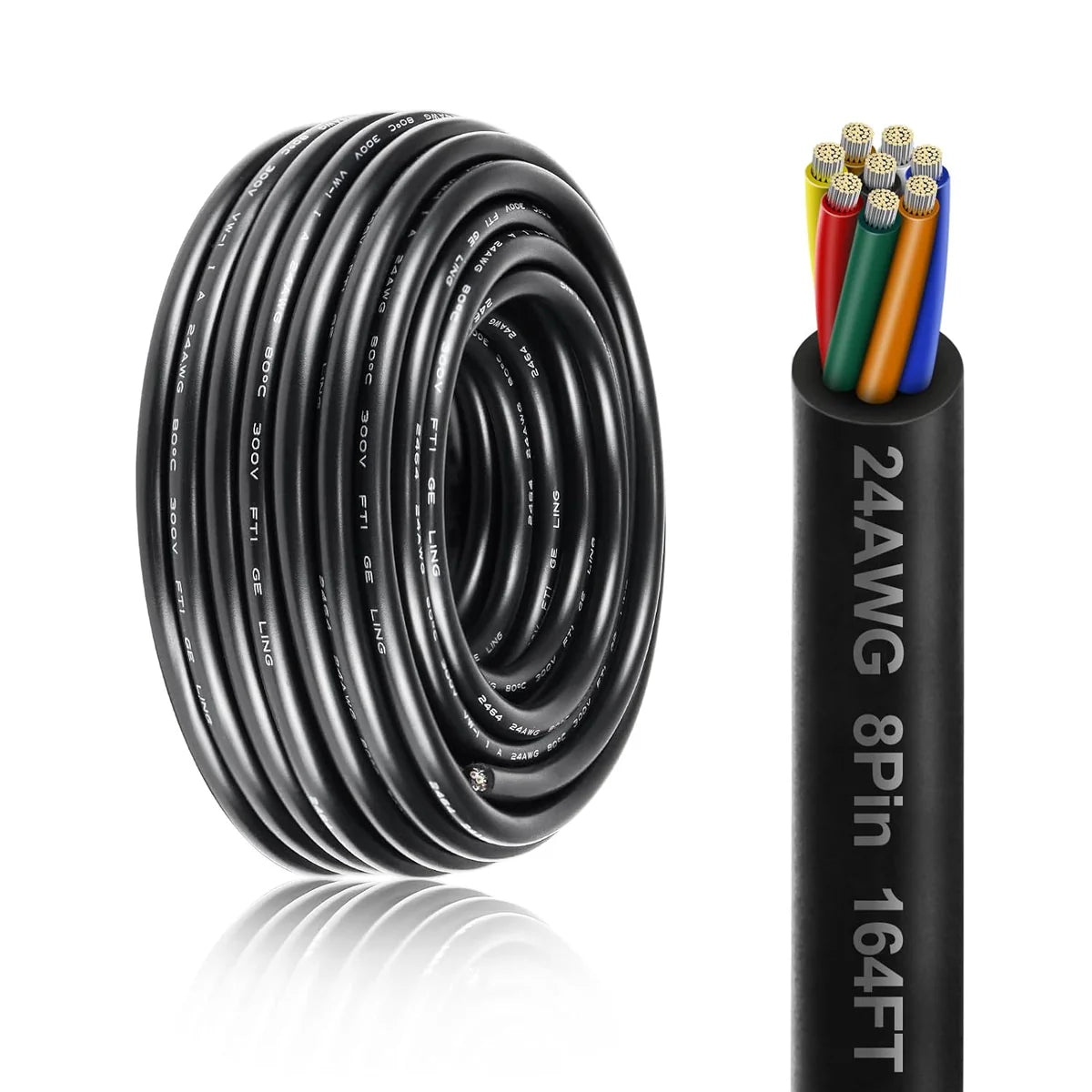
Available 2, 3, 4, 5, 6, 7 and 8-conductor options support simple power connections and more complex multi-wire control layouts.

Durable PVC Insulation
PVC-insulated conductors and an outer jacket help protect wiring from everyday abrasion and mechanical wear during installation and use.

Black & White Jacket Choices
Choose black or white outer jackets to better coordinate with lighting installations, equipment layouts and surrounding surfaces.

5m & 10m Length Options
Available 5m (16.5ft) and 10m (33ft) cable lengths offer flexibility for shorter connections and extended LED lighting or control wiring runs.

Flexible Stranded Copper Cores
Stranded tinned copper conductors combine reliable electrical conductivity with flexibility for routing cables through different installation spaces.
Questions, projects & expert answers
Explore real customer questions, application ideas and answers from our team.
Featured discussion · Buying guide
14 AWG, 18 AWG or 24 AWG — which wire size should I use for my LED project?
Choose the wire around the load, run length and installation
Answered by LightingWill
Official answer

July 18, 2024
Answered by LightingWill
How do I know whether I need 2, 4, 5 or even 8 conductors?
Count the separate power, color and control lines the system needs

July 18, 2024
Customer question
Should I buy the 10m cable and cut it down, or use separate 5m runs?
Planning the cable route before choosing the roll length
Application case
Using one multi-conductor cable made the wiring behind my display cabinets much cleaner
Fewer loose wires running between the shelves and controller
No discussions in this category yet.
Buying guide
Lighting Specialist
14 AWG, 18 AWG or 24 AWG — which wire size should I use for my LED project?
I’m wiring a few different LED projects and I’m trying to understand how much the wire gauge actually matters.
Some of the runs are just short connections inside cabinets, while another one will go farther between the power supply and the lights.
The collection goes from 14 AWG all the way down to 24 AWG.
Is the general idea that the thicker gauges make more sense for higher-current or longer power runs, while the thinner cable is better for smaller control and signal wiring?
I’d rather choose the cable around the actual job instead of automatically buying the thickest one.
Answered by LightingWill
Lighting Specialist
That is the right way to approach it.
In AWG sizing, a lower gauge number means a physically thicker conductor. The current LightingWill PVC range spans 14, 16, 18, 20, 22 and 24 AWG, with each size available in several conductor-count and length combinations.
For example, LightingWill positions the 14 AWG versions for low-voltage power distribution, LED lighting, control circuits and other heavier wiring applications, while the 24 AWG range is described as a slim, flexible option for control, signal, communication and precision low-voltage wiring. Both use stranded tinned copper and PVC insulation. LightingWill
The correct size still depends on the actual current, cable length and equipment requirements, so do not choose from AWG alone.

Official answer
July 18, 2024
Lighting specialist
How do I know whether I need 2, 4, 5 or even 8 conductors?
July 18, 2024
Conductor count is separate from wire gauge.
A 14 AWG cable can contain two conductors or eight conductors, depending on how many individual electrical paths the system needs.
Answered by LightingWill
Lighting specialist
The current PVC collection is divided into two main conductor groups:
2 / 3 / 4 / 5 Conductor
Useful for many LED power, extension and simpler control applications.
6 / 7 / 8 Conductor
Better suited to installations that need more separate control, signal or power lines inside one outer jacket.
For example, the current 14 AWG range offers both 2–5 conductor and 6–8 conductor versions, while the same general structure continues through the smaller wire gauges.
LightingWill lists the 6/7/8-conductor versions for applications including LED systems, electrical controls, communication equipment, automation and other multi-line wiring.
Choose the conductor count from the wiring diagram of the actual equipment rather than assuming more conductors are automatically better.

Customer question
Lighting specialist
Should I buy the 10m cable and cut it down, or use separate 5m runs?
I’m wiring LED lighting across a built-in shelving unit and the total distance will probably be somewhere around seven meters once I route everything properly.
I see the same cable offered in both 5m and 10m lengths.
Would it normally make more sense to buy the 10m version and cut it to the lengths I need rather than joining two shorter cables together?
I’m mainly trying to avoid unnecessary connections inside the cabinet.
Answered by LightingWill
Lighting specialist
If one continuous cable can cover the planned route, using the appropriate longer length can reduce unnecessary intermediate joints.
The current PVC collection offers separate 5m (16.5 ft) and 10m (33 ft) versions across the gauge and conductor families.
For example, the 20 AWG 6/7/8-conductor 10m version uses stranded tinned copper, black or white PVC insulation and is intended for LED lighting, low-voltage power, control and communication applications.
Measure the actual routing path—including corners, service slack and the distance to connection points—before cutting the cable.

Application case
Lighting specialist
Using one multi-conductor cable made the wiring behind my display cabinets much cleaner
I originally had several separate wires running behind a set of display cabinets and it worked, but the back of the unit was getting pretty messy.
When I rebuilt the lighting I switched to one multi-conductor cable for the longer section between the controller area and the shelves.
That made it much easier to route and clip everything along the back of the cabinet.
I used black cable because the back panel is dark, so even the short exposed sections are hard to notice.
The main thing I learned was to label the conductors before connecting both ends. Once everything is inside one jacket, it’s much easier to lose track of which wire is doing what.
Answered by LightingWill
Lighting specialist
A multi-core cable can be useful when several low-voltage conductors need to follow the same route.
The current 18 AWG versions are available with 2, 3, 4 or 5 conductors, in Black or White PVC, with 5m and 10m lengths available in the collection. LightingWill lists the cable for LED lighting, low-voltage power distribution, control circuits and similar wiring projects.
Planning the conductor assignments before installation—and labeling both ends—can make future troubleshooting much easier.


JUST ARRIVED
New LED Aluminum Channels
Fresh Designs. Seamless Lighting.
Meet our latest LED aluminum channel additions, designed to bring a clean, modern finish to your lighting projects.
DISCOVER NOW